

Last modified November 4, 2026 by Jarjar
It's the beginning of autumn, and the time of year when the great annual mass ofEssen is just around the corner. For those unfamiliar with this event, the world's largest gaming event, I invite you to read my article about last year's edition. hereI won't have the chance to participate this year, but... there's a good opportunity for 2027 =) Stay tuned!!

As I did last yearAnd given the enormous success of this article, I'm doing it again this year, in an improved version 😉 So, for the past few weeks, I've been reading about upcoming releases, watching videos about the new games that will be presented, and even glancing at the rules of some. Several caught my attention, and I'm compiling a top 12 list this year, with some additional information. I've also included some references at the bottom of each game entry ( video, rules, as well as (my purchase intention) to help you quickly form your own opinion. New this year, I've noted in bold the unique characteristics of each game.
Please note that I have not played any of these games yet. Even though some were delivered this summer via their Kickstarter or Gamefound campaigns, or through pre-orders, this ranking is based on my initial impressions from my reading and the visuals presented so far on BGG and social media. I haven't included any expansions in this ranking, and I'm only including games that should be on sale at the show. This list is limited; I've certainly missed some notable titles. It's impossible to cover the entire list, which contains nearly a thousand new releases! Feel free to add your own in the comments!
Happy reading =)
#12 :: GAUDI (1-4 players)
I begin this list with the excellent Dani Garcia (Barcelona, Daitoshi), a game that seems lighter than what he usually offers us, but which immediately hooked me with its aesthetics: it's pretty, colorful and full of little mosaic pieces that really make you want to play.
Here, you don the smock of an architect to create works inspired by Catalan Modernism, and more specifically by the world of Antoni Gaudí. At the heart of the game is trencadís, a mosaic technique using irregular fragments of broken ceramic, which Gaudí widely popularized in his creations. It's a wonderful way to ensure that the theme isn't merely decorative, but directly connected to the elements you're working with.
Its distinctive features The final score only retains the two lowest scores (double points for the lowest score) out of three progression tracks. And it is precisely the small trencadís pieces, with their shapes and colors, that give the game its distinctive visual personality. The choice of pieces and their use thus become both a developmental element and a way to gradually build our own Gaudí-inspired universe.
One small detail I found particularly charming: 2026 marks the centenary of Gaudí's death, and there's a lovely tribute at the very end of the rulebook. A small touch that perfectly complements a game entirely dedicated to his world and architectural legacy.


Rulebook (EN)
(EN)
Hmm, I think I'll try before I buy.
#11 :: DROPS OF EVIL (2-4 players)
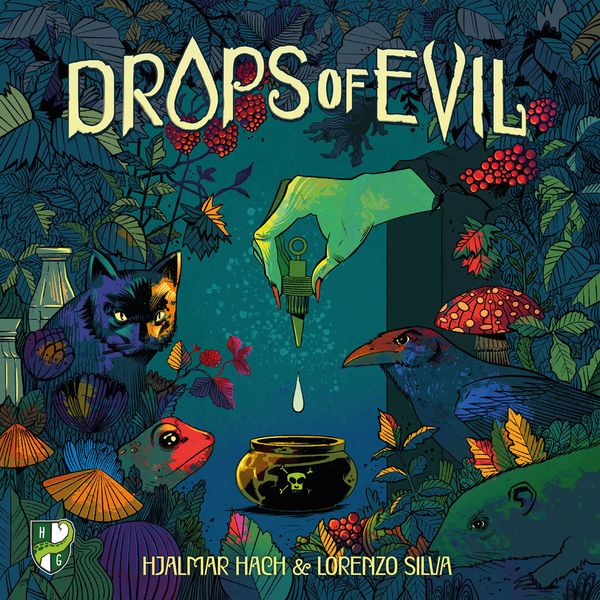
Witches vying to create the most potent poison, familiars sent into the forest to gather ingredients, an alchemical lab to optimize, and recipes to complete: Drops of Evil offers a rather intriguing mix of mechanics. These include worker placement with different types of familiars, ingredient gathering, pattern building, and a genuine spatial puzzle in its Alchilab, further complicated by assistants and recipes that modify our options. The result is a unique blend of interaction for resource access and optimization of our own game space.
His particuliarityThat's precisely what Alchilab is all about. The ingredients we collect aren't simply valuable on their own: their placement in our grid influences their toxicity and can unlock various bonuses. Therefore, we need to think about how we gradually build our grid rather than simply accumulating the right ingredients. This spatial puzzle element, combined with worker placement, seems to be at the heart of the game.
There's still relatively little information and, above all, little player feedback on Drops of Evil. I added it to my list of games to watch several months ago, without noting the source of the recommendation—probably a podcast. But its rather unique visual style had caught my eye, and now that the mechanics are a bit better understood, the blend of worker placement and optimization puzzles seems interesting. So I'll definitely be keeping an eye on it! It will be available in limited quantities at Essen.

Rulebook (EN)
No video available
I'm still hesitating, but I'll definitely buy it!
#10 :: OIL ROCK (2-4 players)
I played a lot of Oil Imperium on my Commodore 64 when I was younger, and I was really fascinated by the game! So naturally, Oil Rock immediately piqued my curiosity 😉
Here, we delve into the heart of the industrial revolution as each player takes the helm of an ambitious oil company. You'll need to develop your empire by optimizing the entire production chain: building wells, upgrading refineries, developing turbines, expanding your railway network, and establishing a presence in the most strategic regions of the map.
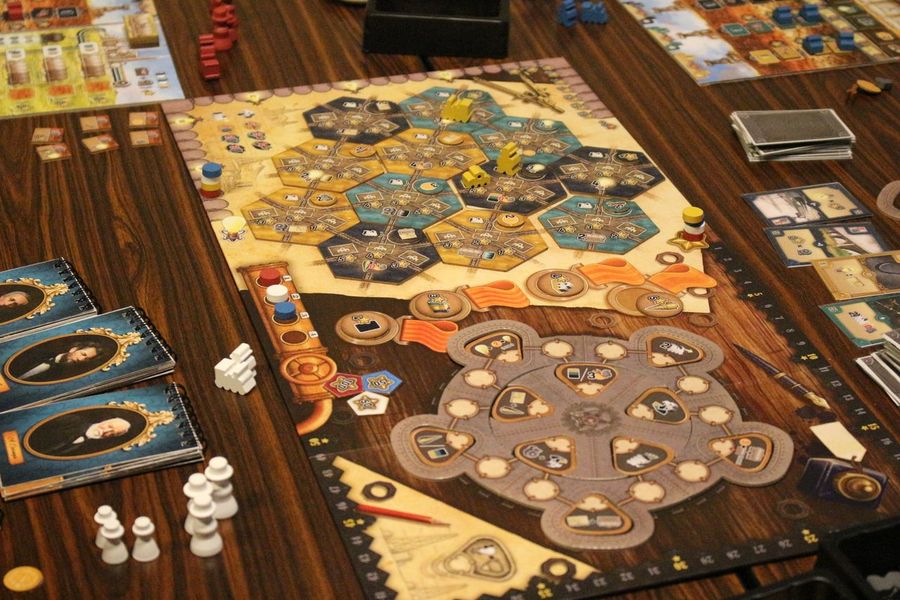
The core of the game revolves around an action wheel that spins throughout the game. You place your workers on it to perform different actions, which does indeed create a slight feeling of... Barrage in the way you plan your moves and, above all, think about the right moment to take advantage of an opportunity. The hexagonal map and the development of the railway network also reminded me of certain aspects of Nucleum, particularly that feeling of gradually building your network while trying to benefit from the bonuses linked to its placement.
His particuliarity Character Notebooks: You don't simply choose a character with a fixed power for the entire game. Their development evolves throughout the game, allowing you to progressively unlock new abilities, improve their effectiveness, and increase their income. This gives each character genuine progression rather than just a simple, asymmetrical starting power.
With its drilling, refining, turbines, patents, railway network and character development, Oil Rock seems to be focusing as much on optimizing its company as on timing: knowing what to develop, where to set up shop and above all when to turn the wheel.
Rulebook (EN)
(FR)
Almost guaranteed purchase
#9 :: TIMESPAN (1-4 players, complexity 3.5/5)
A short civilization game that takes us on a journey from the Stone Age to the Space Age. Timespan invites us to develop our people by focusing on discoveries, scientific advancements, culture, exploration, and building a powerful economy. All this in about 90 minutes and, rather unusually for a civilization game, without any war. Here, there is no military conquest: the emphasis is entirely on the peaceful aspects of developing a civilization.
Its distinctive features The back of the main board is a smaller version of the full board, allowing for play on a small table. On our board, you can only keep 4 cards at a time. The fading past: As soon as we play a 5th card, it pushes out the oldest card in your row. The legacy: The card that is played out doesn't completely disappear; it goes into a special area ("legacy") to give us points or income until the end of the game, which forces its people to move forward without forgetting everything.
Another interesting element: the vast majority of the action phase takes place simultaneously. While each player develops their own civilization, their culture and science advance, new technologies are unlocked, transportation is developed, and access to increasingly rare luxury resources is gained. The game also offers six asymmetrical civilizations and six different technological platformsThis already offers 36 starting combinations before even taking into account the numerous character cards, buildings, technologies and wonders available.
Timespan therefore seems to be aiming to offer a true civilization experience, but more condensed than what we are used to: a lot of development, progression and optimization in a relatively short game.

Rulebook (EN)
(EN)
I will try before I buy
#8 :: DRILLERS (1-4 players, complexity 2.66/5)
In this game, we take control of powerful drilling mechs to explore a mine abandoned by a forgotten corporation. The objective: descend ever deeper to extract the precious minerals hidden there, then manage to return to the surface to sell them and upgrade our equipment. But the deeper we go, the more precious fuel becomes, and the more carefully we must calculate our return.
Drillers is a deck-building and resource management game in which each card is versatile: it can be used to produce fuel or be used for its effect, notably to drill or move.
Its distinctive features A card holder included with the game keeps the top card of your deck visible, transforming the draw pile into a true planning tool. The game also features a particularly interesting card retention mechanic: you can keep certain cards in your hand to prepare for your next turn and build combinations with the card you know is at the top of your draw pile.
Some retailers have already received their copies, and players were also able to try the game at Gen Con. Initial feedback seems quite positive so far, particularly regarding the game's fluidity, its theme, and the decisions related to fuel and depth management. Its release is scheduled for very soon!

Rulebook (EN)
(FR)(EN)
I will try before I buy
#7 :: BRAIDED SKIES (1-5 players)
A new game from the excellent publisher Stonemaier Games, designed by Dan Germain (a relatively unknown designer) and beautifully illustrated by Andrew Bosley (Everdell and Tapestry), was recently announced on September 23rd. It looks like a pretty substantial game, with a touch of Galactic Cruise in its tourists. The game will be available soon, just in time for Essen!
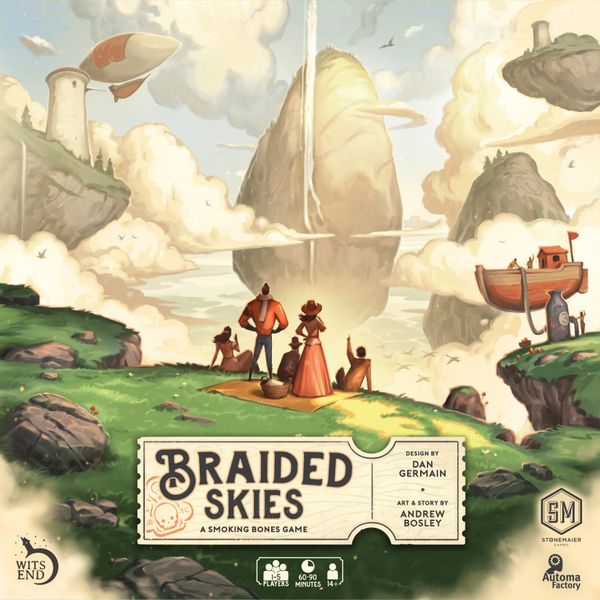
Braided Skies transports us to a fantasy world where we manage an airship company tasked with transporting tourists, gathering resources, discovering wonders, and developing our network.
His particuliarity : it seems to rely on its three airships which are sent to explore different destinations before being recalled to trigger actions and take advantage of accumulated improvements.
In addition, there's a map partially hidden by clouds that are gradually revealed, changing the possibilities available to all players. It's not a new mechanic, but the combination of progressive exploration, airship placement, and "improved" recalls gives the game a rather unique identity.
And there's another aspect that particularly intrigues me: Smoking Bones, the universe in which the game is set. It's not simply a pretty backdrop created to accompany Braided Skies. Andrew Bosley has been working on this universe since 2012-2013, long before the board game project even began. He tells the story of Captain Red Jones and the Smoking Bones Travel Company, a company that explores the Northlands to discover, promote, and above all, preserve the magical wonders of the world.
Bosley has already published The Smoking Bones Travel Guide: Brandimir, an illustrated book dedicated to this universe, and his project goes much further: he plans a series of four illustrated novels, accompanied by three board games published by Stonemaier Games, as well as other guides and materials to delve deeper into this universe. Braided Skies is therefore only the first piece of a much larger project.

Rulebook (EN)
(EN)
Several friends are going to buy it
#6 :: ENTROPY (1-4 players, complexity 3.51/5)
The game is generating a lot of buzz in the community, particularly because it brings together three big names in Italian strategy games: Simone Luciani (Darwin's Journey, Barrage), Nestore Mangone (Darwin's Journey, Newton) and Tommaso Battista (Barrage). That alone certainly sets the bar quite high!
In EntropyIn this game, we play as apprentice scientists who must pass their final exam within a cutting-edge scientific simulation. Our mission: to shape new solar systems, evolve stars, create planets and biomes, and then introduce life to them. We can also collect asteroids, upgrade our scientific console, and develop various abilities. This theme particularly appeals to me, especially since it's treated as a true simulation rather than just a space-themed backdrop. Of course, some scientific concepts are simplified to serve the game, but overall, the mechanics and theme seem to flow together beautifully.
Its particularities: Its double orbital rondel and all the positioning management that comes with it. Each turn, our scientist moves 1 to 3 spaces clockwise. Internal actions require placing our Creation tokens on the board, and these remain there until we pass over them again to collect them. By collecting them, we can, among other things, activate a star or gain Entropy. The slight puzzle comes from the fact that a short movement provides better bonuses, but a longer movement allows us to get closer to certain tokens.
The first shipment has already been sent to those who backed the game on Gamefound, and it should be available in stores soon. We're starting to get some feedback. Some are very enthusiastic, while others, more ambivalent, point out that, despite the reputation of Luciani, Mangone, and Battista, the game is primarily an excellent, classic, and solid Eurogame, without revolutionizing the genre like Barrage or Darwin's Journey did.
The look, the theme, and especially this trio of authors hooked me. After watching the rules video, I have to say there seems to be a lot going on. Between managing the rondel, the Creation tokens, the stars, the planets, the biomes, the life cards, and the various objectives… I'm really looking forward to trying it out!

Rulebook (EN)
(EN) (FR)
Guaranteed purchase
#5 :: QUEEN ALICE (1-4 players, complexity: 3.93/5)
A very attractive production that seems truly impeccable to me!
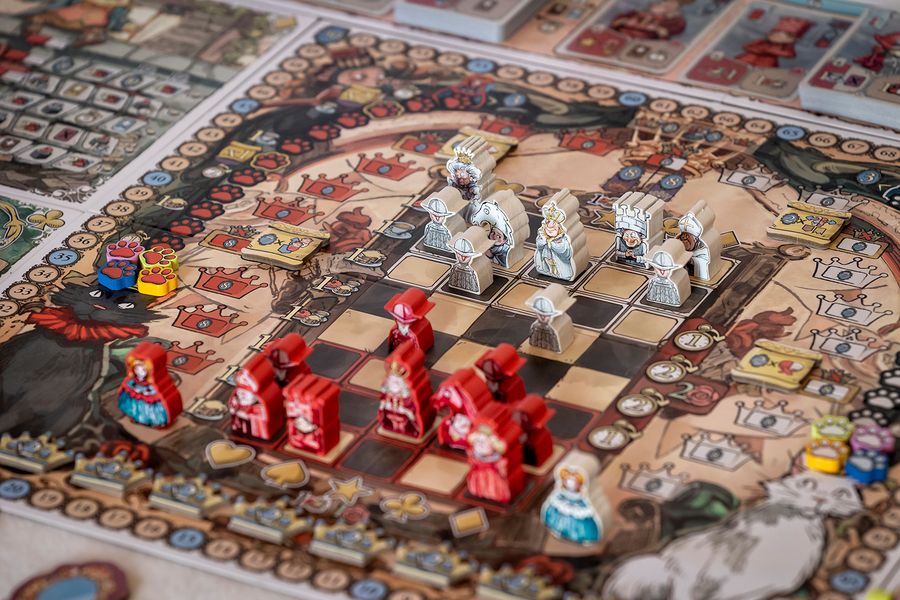
In this game, Alice has gone through the looking glass and finds herself on the other side, in the heart of a kingdom inspired by the universe of on the other side of the mirror by Lewis Carroll. The kingdom is preparing to celebrate its coronation, and the players take on the roles of members of the Court tasked with preparing the grand banquet. Their objective: to convince the various chess pieces to help them prepare the most prestigious banquet possible and thus become the chief advisor to the new Queen.
We find a mechanism that may remind us of Ayar: Children of the Sun The chess pieces are shared by the players, and their movement on the board influences the entire game. But Queen Alice seems to push the integration of this idea much further into the heart of its system.
Its particularities: Queen Alice literally transforms the movement of chess pieces into the game engine. The cards you play activate the different pieces, and their movement determines the action performed. A knight, a rook, a bishop, or a queen won't simply move differently: each one opens up different possible actions. It's an idea I find truly intriguing! As the game progresses, you also acquire upgraded cards that enhance these actions and allow you to gradually build your own engine.
And there's another interesting layer: players also try to influence the color of Alice's coronation. Depending on the influence they accumulate, she could become the White Queen, the Red Queen… or even both! This race for influence adds a wonderful dimension of indirect competition to the game.
The initial feedback seems positive; some players feel the game is made up of several small, interconnected systems rather than one obvious central mechanic. I'm absolutely thrilled to try this one!
Rulebook (EN)(FR)
(FR)(EN)
Guaranteed purchase
#4 :: KINGDOM COME DELIVERANCE (1-4 players, complexity 3.75 / 5)
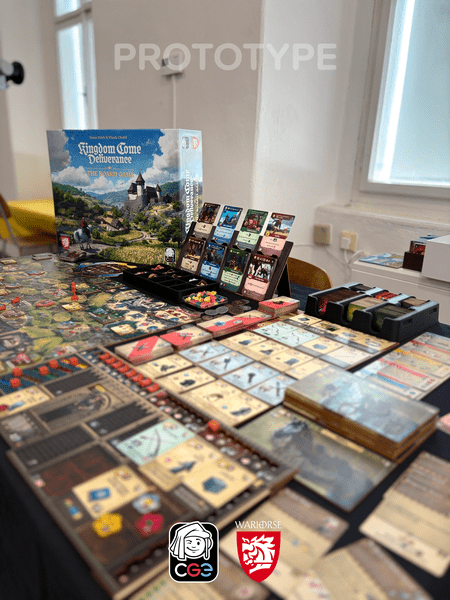
This game is certainly one of the most ambitious projects announced this year in the gaming world. Developed by Czech Games Edition (CGE) and designed by two major figures in modern board games, Tomáš Holek (SETI) and Vlaada Chvátil (Codenames, Through the Ages, Mage Knight), he brings the realistic medieval world of Warhorse Studios' famous video game to our tabletop. And this is their very first collaboration!
The game isn't even officially released yet, but it's already generating buzz. Previewed at Gen Con 2026, it was notably named by Board Game Quest as one of their best experiences at the show. That's pretty encouraging for a game still in development! And I have to admit, it makes me even more eager to try the game now! 😉
CGE has taken a gamble on a competitive, entirely analog adventure game (without an app). The game anchors players in the 15th century, without a trace of fantasy or magic: it features the raw realism, mud, politics, reputation management, and social survival that define the Warhorse Studios franchise.
Although competitive, the game avoids direct conflict between players. There are no player-versus-player battles; instead, each player progresses through their own achievements. You may even encounter other players in the same locations on the map, where sharing valuable experiences can help you overcome challenging skill tests.
At the end of the five days, the player who has amassed the most points, by completing quests, advancing storylines, acquiring equipment, building relationships and much more, will be declared the winner.
Its particularity : to succeed in transposing the freedom of an open-world RPG into a deck-building Eurogame, where everyone can develop their character and build their own story rather than following an imposed scenario.
Rulebook (EN)
(FR) (EN) (EN)
I'm going to play with my friend Jeff's copy =)
#3 :: CLASS OF '89 (1-4 players, complexity 3.0/5)
In third place on the list, a game that takes me straight back to my high school years! It brings back great memories of that time and a wonderful dose of nostalgia. Very cool! =)
Class of '89 is a new game from the relatively unknown Kory Jordan, with art and graphics by Erik Evensen (Distilled). The game transports us to 1989, where we play as the president of the yearbook club. Our mission: to create the most memorable yearbook possible by immortalizing the defining moments of this final year of high school. From football to various extracurricular clubs, every memory can contribute to our yearbook.
The game seems to offer a very interesting mix of worker placement, tile placement, set collection, and pattern building. You recruit students, assign them various attributes, and try to group them strategically to maximize your points and achieve your teachers' objectives. Clubs also play an important role: certain student associations allow you to progress on different club tracks and earn rewards.
Its distinguishing feature: The requirement to respect alphabetical order means students must be seated according to the first letter of their last name. This seems to transform student placement into a real spatial puzzle. It requires juggling the alphabet, student attributes, teacher objectives, proximity, and clubs. A simple thematic idea, but one that seems to add a welcome constraint to the creation of the yearbook.
I'm really drawn to it because of its theme, which I find very cool and original. Early reviews suggest it's not too complicated, but it has a nice depth.

Rulebook (EN)
(EN)
Guaranteed purchase
#2 :: ASHES BLACKOUT PROTOCOL (1-4 players)
This game was initially higher on my list, but after watching Radho's video… OMG, I was blown away! I can't wait to try it!
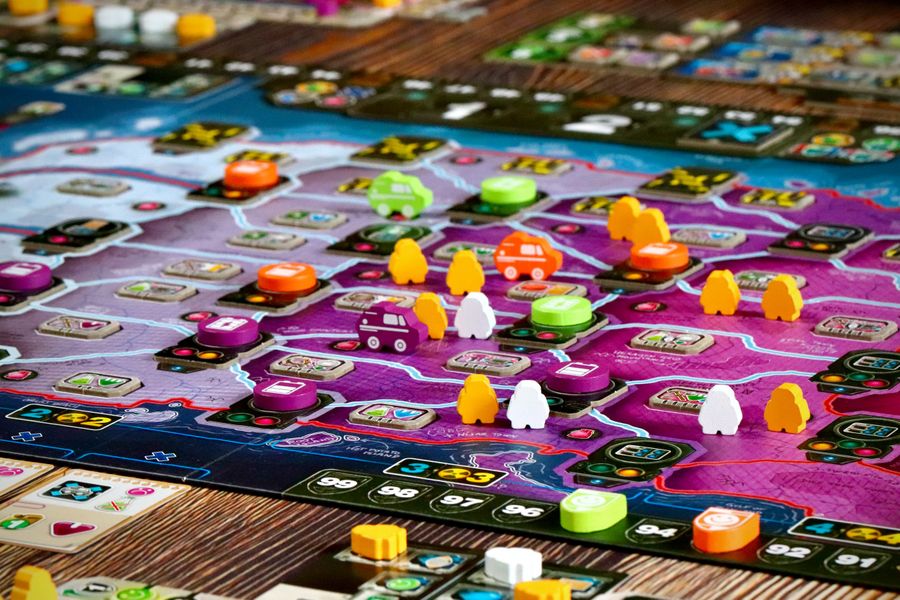
The game takes place in 1989, following a nuclear Third World War that devastated the Earth's surface (is this a vision of the near future? Rest assured, I certainly hope not). To survive, humanity was forced to retreat underground. We play the leader of an underground colony (part of the ASHES protocol for Artificial Shelter & Human Evacuation Sequence) who sends an evacuation team to the surface to rescue survivors, salvage materials, and contribute to "Project Phoenix." Our objective is twofold: to ensure the survival and development of our own people, while also participating in Project Phoenix, the global initiative aimed at restoring the surface and giving humanity hope.
Despite its rather dark post-apocalyptic theme, I really like the contrast with the very colorful art direction, with quite vibrant colors that give the game a very particular personality.
Its distinctive features The shelters we build aren't just for housing survivors and generating recurring income. Once full, they can be flipped to their completed side: their income is then sacrificed to gain more victory points each round. So, you'll have to choose between maintaining a source of income or transforming the shelter into a longer-term investment. There's also this mix of a tech tree (where you can downgrade) and managing your vehicle's movement: each trip consumes fuel, and the vehicle allows you to rescue survivors, perform certain actions, and collect the materials needed for Project Phoenix. Lots of parameters to keep track of—it sounds absolutely fantastic!
Ashes lays the historical groundwork and sets the tone for the underground struggle that leads up to the events of the excellent game Phoenix New Horizons. In fact, some of the game's components and mechanics are recognizable.
I'm really looking forward to seeing it in my game collection 😉
Rulebook (EN)
(EN)
It's pre-ordered =)
#1 :: -60 ° (1-4 players, complexity 3.5/5)
I'm finishing this list with a game that was reportedly developed over almost six years And when you learn that it went through 79 versions!s Before it's considered finished, it makes you want to see the result even more. The story of its creation is quite fascinating and is very well told by Peter Prinz in his design journal on BGG.
And pay attention to the title: -60° refers to latitude, not temperature!
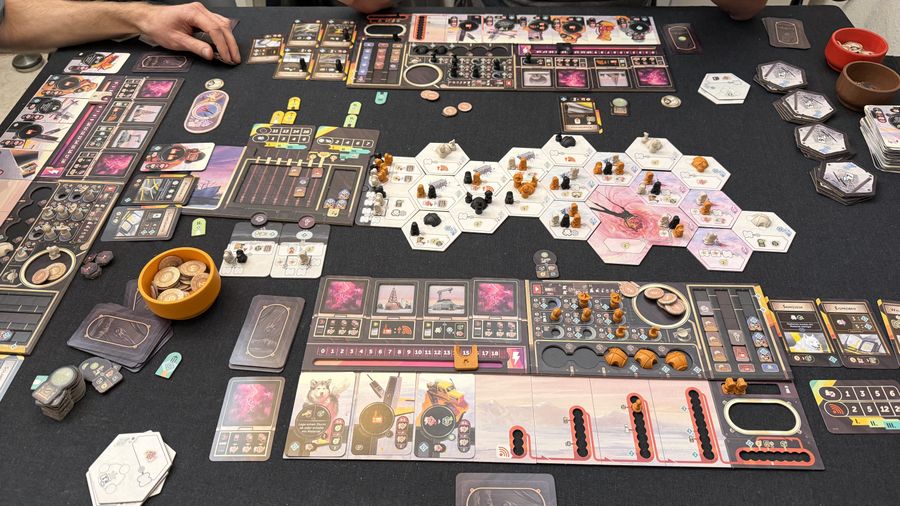
This is shaping up to be a big game, with a lot of components (2,9 kg box): 140 RE-Wood miniatures, 240 cards, over 250 tokens, and 70 board pieces packaged in 20 punchboard sheets. It's a hefty package!
The game plunges us into an alternate version of 1971. On September 23rd, at 23 PM, a strange light crosses the sky before a mysterious object crashes a few hours later somewhere in Antarctica. Several research teams then land on the icy continent with a clear objective: to establish an efficient network of stations, explore this hostile region, and above all, reach the mysterious impact site.
To achieve this, you'll need to combine resource management, technology, exploration, and risk-taking. The game blends worker placement, deck-building, hand management, and push-your-luck elements, all within a long expedition where your choices will gradually transform the game board.
Its distinguishing feature: A worker placement system where you place your workers and they remain there for the game. A user commented on BGG: The permanent worker placement system that forms the basis of your stations is truly brilliant! It's exactly the level of interaction I look for in such a complex management game.
I'm completely captivated by the theme and the world, and this permanent worker placement mechanic has everything going for it. Almost six years of development, just as many versions… I can't wait to get my hands on it and see how it plays around the table!

Rulebook (EN)
(FR) (DE)
Guaranteed purchase
OTHER MENTIONS
Orlando (1-4 players)
A new game from Stefan Feld is always an event! However, I haven't found any confirmation that it will be for sale at the convention. I suspect it will likely be playable as a prototype, which is why I'm mentioning it in this section.
In this game, you build your own amusement park and make it the most popular place in the region. The concept is original: each turn, you roll eight 16-sided diceEach die offers two distinct actions. The gameplay is simple yet tactical: Choose a die and perform its two actions. Choose a second die and do the same. Four actions per turn to outmaneuver your opponent and build the ultimate park!
The image below looks like a prototype, at least I hope so, but at the same time, being used to Feld, it's possible that it's the final version too!

Rival Seas (2-4 players)
A game that started in my top 10 initially, but as I mentioned earlier, my ranking has changed a lot while I was writing this article!
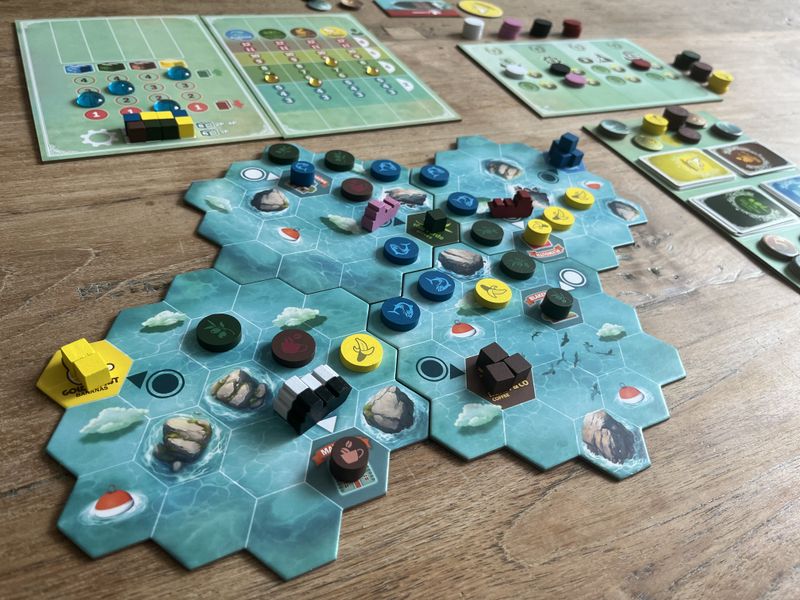
So here we have an economic game where we'll build shipping routes, transport containers, deliver goods, invest in companies, and become their CEOs. Company money and our personal money are separate, as in many games of this type. It's also a game where time plays a significant role, using a familiar mechanic: the last player on the time track takes their turn. It's a game in the style of 18XX, but smaller and therefore seems lighter to me.
It's not a gaming revolution, and there's nothing particularly new in terms of mechanics, but I really enjoy economy games. Here, the compact format, which doesn't seem to take up too much space on the table while still retaining a certain charm, combined with a type of game I usually enjoy, piqued my curiosity.
Rulebook (EN)
(EN)
I will try before I buy
The Mix (1-4 players)
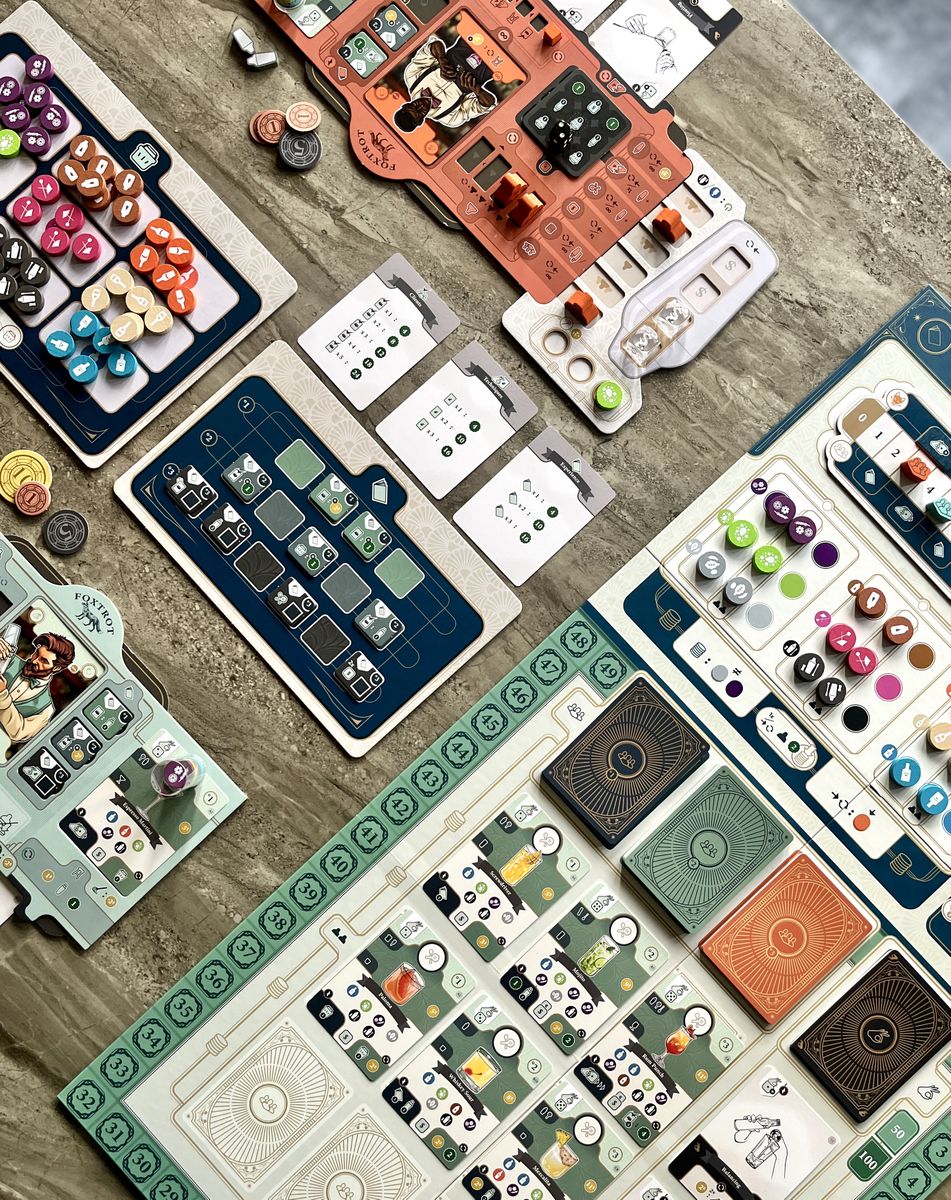
The Mix caught my eye last year at the Quebec City Toy and Game Fair, where its creator was promoting it. A magnificent and visually striking production!
The game explores a rather original theme: mixology. You play as a bartender at the start of their career at the Foxtrot Bar, with the goal of perfecting their skills, learning new recipes, managing their ingredients and satisfying an increasingly demanding clientele.
Behind this rather catchy theme lies a worker placement and engine-building game, where each new technique acquired can make our actions more efficient and allow us to create more complex combinations. The Mix seems to aim for a relatively accessible Eurogame while still leaving enough room for optimization. It may not be the game that reinvents the genre, but the combination of theme, character progression, and engine building intrigues me enough to want to see how it turns out. And what's more, it's a Quebec production!
Rulebook (EN)(FR)
(EN)(FR)
I'm going to play with my friend Jeff's copy, again =)
Chronocriters (1-4 players)
A game I'd missed in my research, and which my boyfriend Jeff suggested I check out. It certainly looks like a big production! And with a touch of Vladimír Suchý, it adds a lot of interest!!
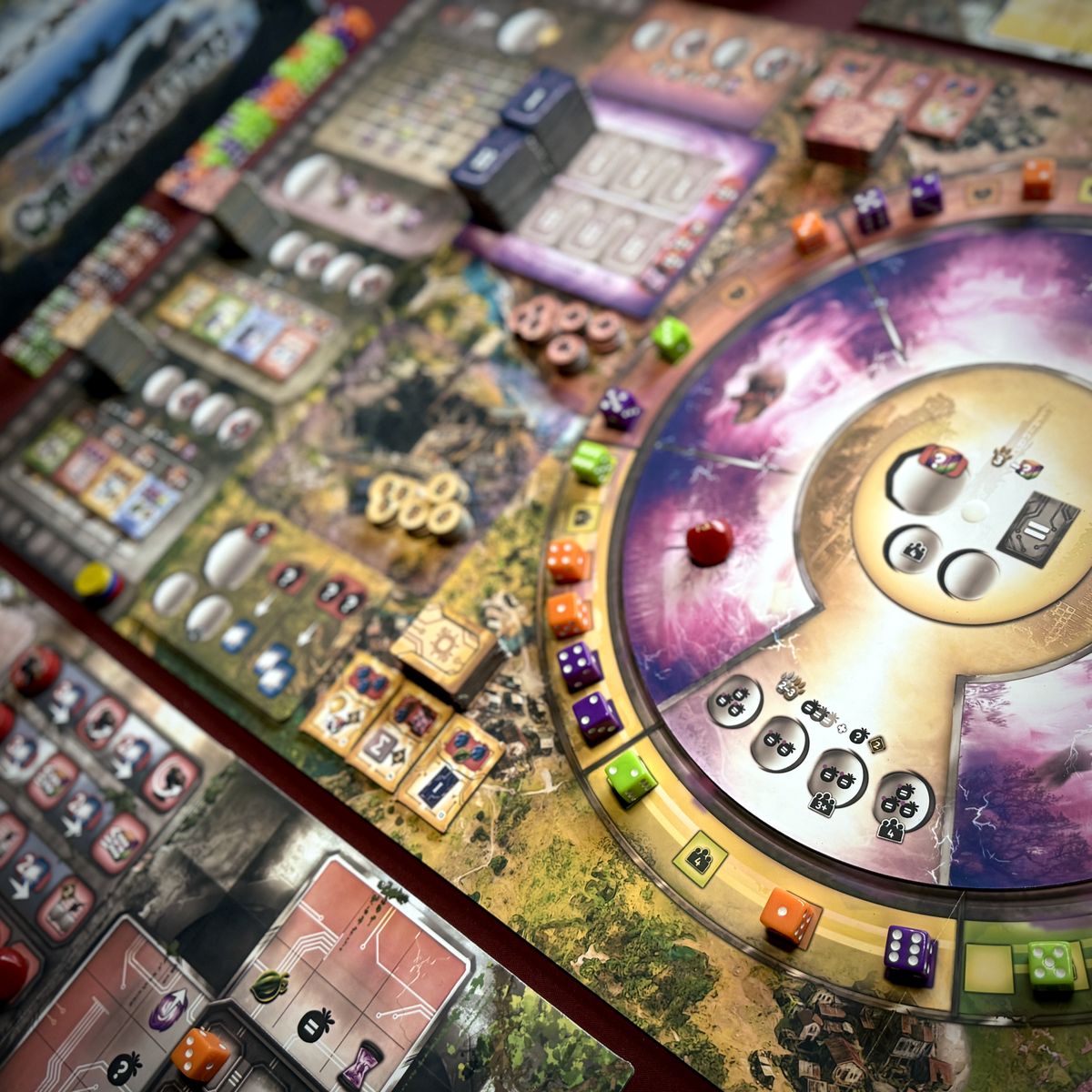
Chronocritters plunges us into 2562, a world where a catastrophe has torn space-time apart. To reconstruct reality, players can rely on curious robotic animals capable of traveling through different periods: the Chronocritters.
Behind this rather original theme seems to lie a fairly robust game combining worker placement, dice, resource management, and planning. The core of the game revolves around different time periods: certain actions and resources are only accessible at specific times, and players can build time portals to access other periods. These portals deteriorate over time, however, which appears to add a significant layer of planning.
With its modular board, contracts, variable powers, and multiple ways to develop your engine, Chronocritters seems to offer plenty of decision-making and optimization opportunities. It's a game that doesn't appear to reinvent worker placement, but it leverages its time-based theme to create interesting constraints and, above all, a dilemma that's likely to come up frequently around the table: take an action now or save it for another era.
It gives it a little something extra Anachrony With this idea of using time as a strategic resource, a comparison that comes up in several initial reviews. Another good reason to pay attention to it. 😉
Rulebook (EN)
(EN)
Still thinking about it! Jeff?
Devils (1-4 players)
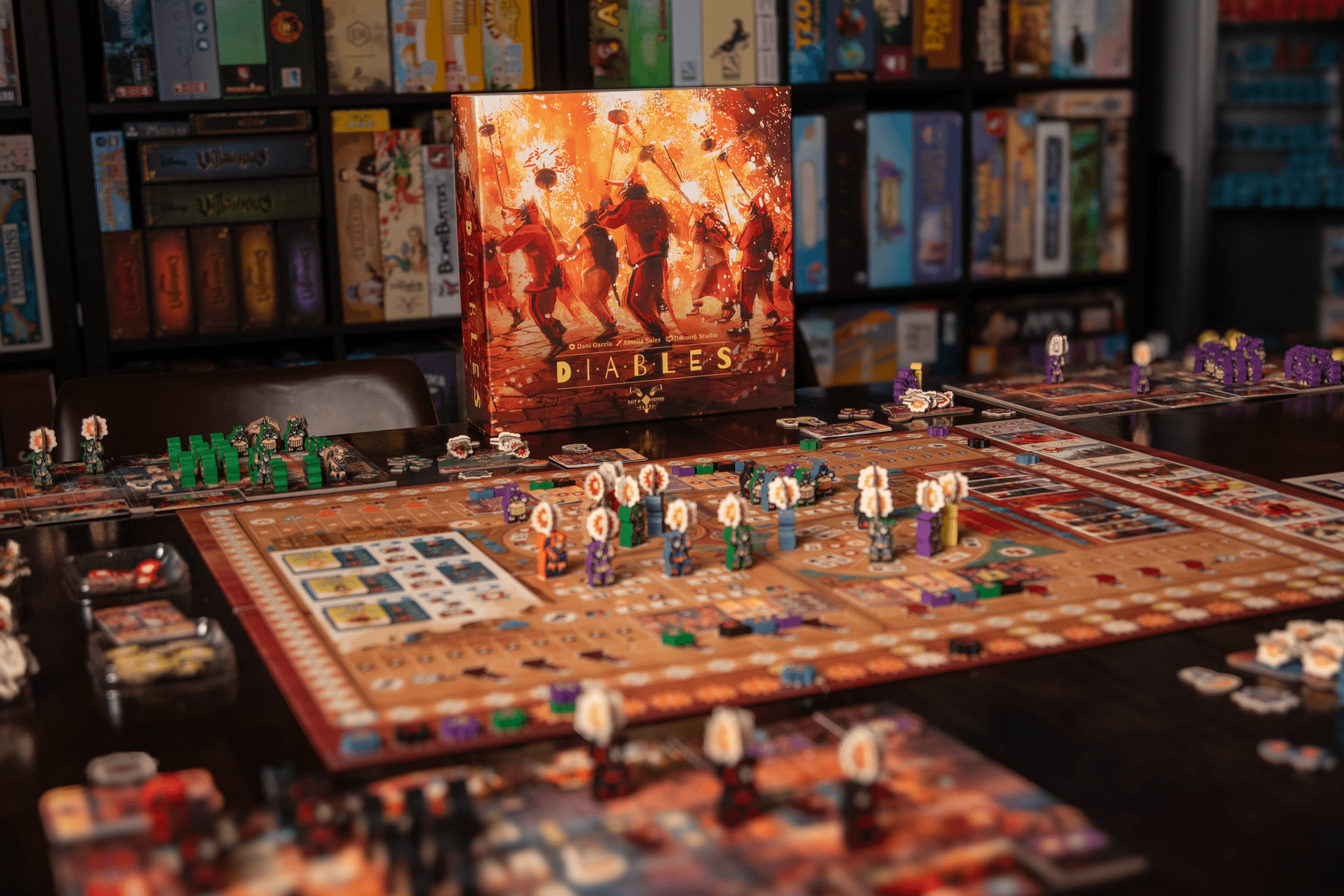
Diables, another new film presented in Essen and directed by Dani García, transports us to the heart of the Ball de Diables, a spectacular Catalan tradition combining parades, music and pyrotechnics.
Mechanically, it seems to be a big game (apparently its most complex yet!) that combines worker placement, resource management, versatile cards, and movement along different tracks. Each player controls their own glue and must place its various artists in the streets of the parade in order to carry out actions, attract crowds and organize its performances.
Its distinguishing feature: Her worker placement strategy is clever, as each artist possesses unique abilities and their effectiveness varies depending on location and the firework they're associated with, making each placement a combination to be optimized. Once again, Dani seems to be innovating with worker placement here!
The cards offer multiple uses, while the movement of the crowd seems to constantly alter the opportunities on the board. Over three rounds, you'll need to carefully plan your actions, manage your resources, and capitalize on the parade's key moments to gain fame and prestige.
CARL VAN LINNÉ (1 – 4 players, complexity 3.8/5)
By an author, Michal Peichl. (Forestry) who is also an artist (Galileo Galilei, Woodcraft, Evacuation, …).
Carl Linnaeus is a board game focused on classification and the discovery of the animal world, inspired by the famous Swedish naturalist who developed binomial nomenclature. Players travel through different regions to collect and identify species, then attempt to classify them correctly according to their characteristics. The game blends set collection, deduction, and card management with an educational element.
His particuliarity Here, scientific classification is not just a thematic pretext: it truly forms the heart of the game. We must observe the characteristics of the different species in order to classify them correctly, transforming a scientific concept into a genuine game challenge.

DOCTOR (2-4 players, complexity 3/5)
From the excellent Stefan Feld, a game that transports us to medieval Europe, where qualified doctors are scarce. We play as itinerant barbers who travel from town to town, seeking the knowledge and reputation necessary to become true physicians. Along the way, we collect remedies, deliver letters for the Church, research medicinal recipes, and acquire instruments or favors.
His particuliarity : the simultaneous and secret choice of one's destination from among seven possible locations: it will be necessary to carefully plan one's route to take advantage of secondary actions along the way, while trying to arrive at the right place before one's opponents.
With only eight or nine rounds to build your strategy and accumulate points in different categories, every decision seems to count.


Rulebook (EN)
(VF)
Further details pending
Carpet Racer (3-5 players)
Another game by Thomas Holek! This author is truly very prolific.
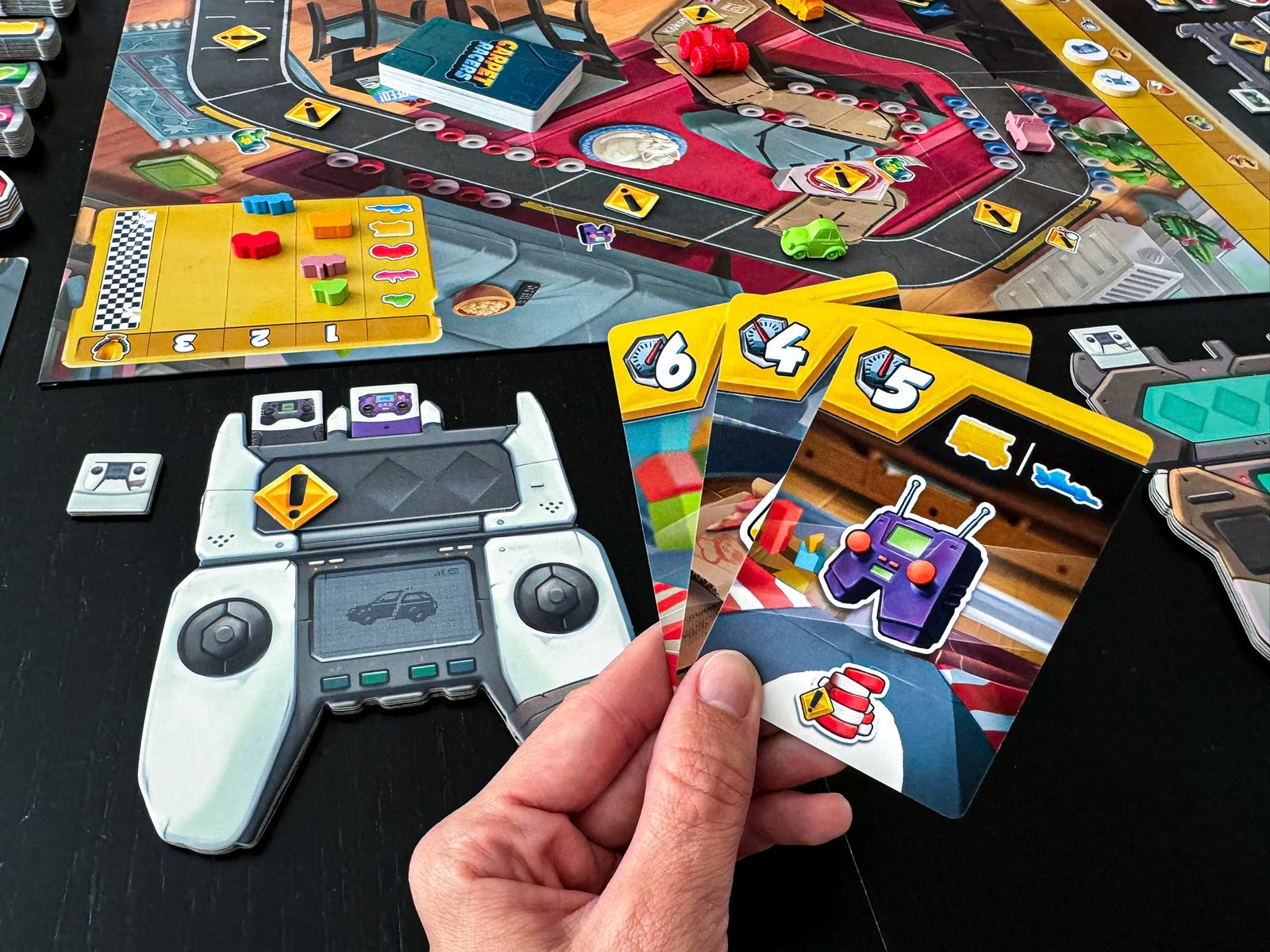
Here, he offers us a car race that seems as original as it is wacky!
Its peculiarity : We compete on a circuit where five cars start, but no one really knows the identity of their own car.
Each turn, you play a card that allows you to move two cars and trigger various effects, while also setting traps, collecting speed tokens, and gathering clues to try and discover which car belongs to you. You must therefore advance your vehicle without arousing suspicion, while covering your tracks and trying to guess your opponents' intentions. A mix of racing, bluffing, and deduction!
Rulebook (EN)
(EN)
Further details pending
EXPANSIONS
Several expansions have already been announced for Essen, and among them, here are the ones that particularly caught my attention:
The White Castle: Bōeki
I absolutely loved the first expansion for this excellent game, which subtly extended the experience with incredible finesse! This new expansion adds a commercial dimension, offering new possibilities for developing your strategy and optimizing your actions. It seems designed to enrich the game without altering its excellent core system. I can't wait to see what they've come up with!
Endeavor: Deep Sea – Uncharted Waters
This expansion takes us even further into the exploration of the deep sea, with new maps, new elements, and more possibilities for developing our expeditions. It's a great way to refresh the gameplay while preserving the core of the game. I thought I'd already explored everything in the base game =), but no!
Crescendo Harmonies
One of the most popular family games here, offering a puzzle that's so much fun to build. The expansion includes 3 new modules that can be used individually or in combination with other modules.
Sanctuaries: Build unique landscapes that can accommodate multiple animals.
New personal game boards offer new terrain layouts and new ways to score points.
Whispering Creatures: Add new cards to your animal cards and create synergies between animals and Whispering Creatures.
A Wild Venture: Revelry et Byways
Two small expansions that add variety to a game I really enjoy!
CONCLUSION
We're now less than a month away from this major board game event, a time of year I always look forward to with great enthusiasm. And this is just the beginning: several other games will be announced before then. This will be the biggest edition yet, as all the pavilions on the site will be occupied! Like last year, I'll be following the new releases, announcements, and surprises surrounding the show very closely.
This year's lineup already looks promising, with several titles that have piqued my interest. But with the impressive number of games released each year, the challenge is increasingly difficult for designers and publishers to offer something that truly stands out. That's precisely what I find interesting to observe: beyond the impressive productions and big names, which games will manage to bring that spark of originality? And above all, which ones will rise to the top of this grand gathering of board games?
